Voltage Difference Causes Charge to Flow From
You cant force a current to flow through some circuit element without applying a voltage across the element. Sometimes it is called a voltage drop.
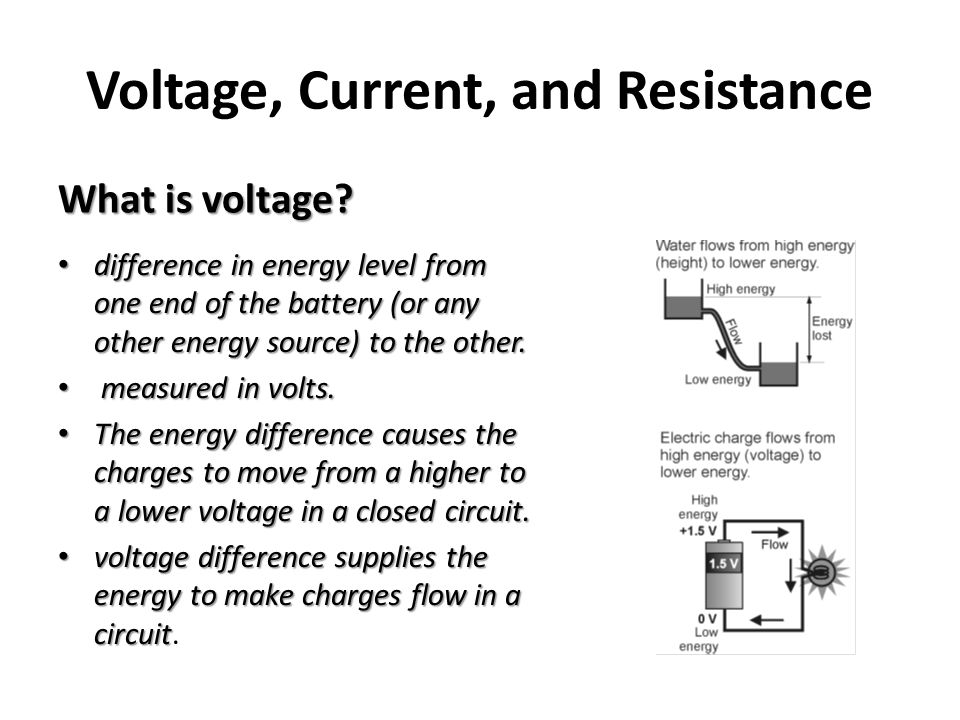
Voltage Current And Resistance Ppt Video Online Download
How does voltage cause charges to flow in a circuit.
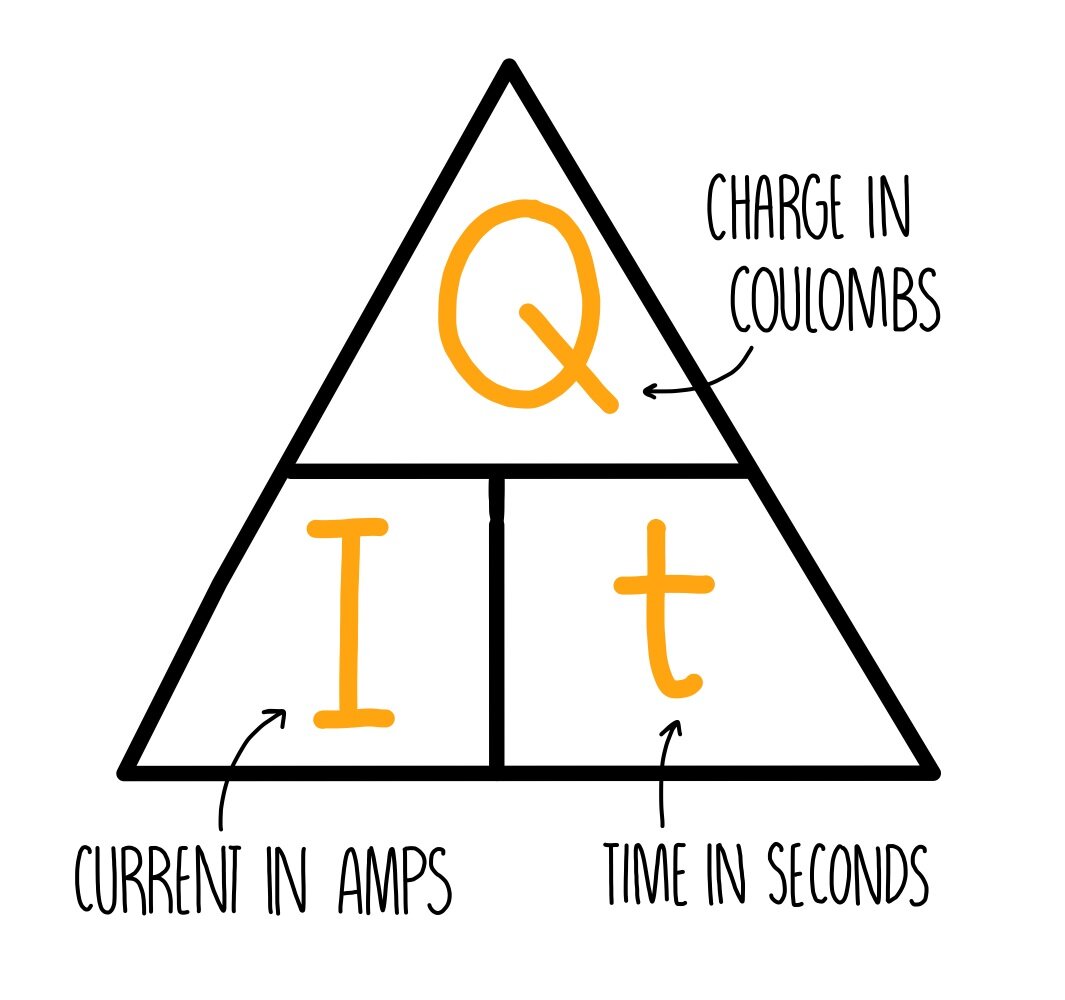
. Conductors are characterized by having charge carriers that are very loosely bound to the bulk material. Voltage is also called an electromotive force. Your voltage is an average -- the power goes in a sine wave from zero to about 150 volts back down thru zero to about -150 volts and repeats this 60 times per second.
Is the term used for rate of charge flow. Normally in circuit theory conventional current is consider most of the time that is from positive to negative of battery terminal. You cant produce a voltage without supplying charge or current to force some place to have that voltage.
Does voltage cause current. That force also then directs the emitted electrons to flow or move in a given direction as a current alongin the conductor. Aelectric charge Bstatic discharge Cvoltage 2 See answers Advertisement Advertisement ngilliam1444 ngilliam1444 Answer.
The mass before a chemical change equals the mass after. Voltage is the potential difference between two points which causes current to flow. True False Answer Bank Voltage flows through a wire.
Here the positive terminal of the battery is at a higher potential and the negative terminal is at lower potential. Voltage is measured in volt V which is the derivation unit of potential. Outlets and batteries both have voltages that are associated with them.
Voltage causes them to flow in a circuit because of Ions and Electrolytes. Batteries supply direct current. In fact whenever electricity is delivered over any.
Like charges on the balloon and wall cause an attraction between the two. Current is the rate of charge flow between two points caused by. Voltage potential difference EMF - they all mean the same thing.
Answer 1 of 2. Voltage will drop in series resistance while the. It is actually the potential difference of charges across two pointsnodesterminals in an electrical circuit.
What is the name for potential difference that causes current to flow. The law of conservation of charge states that _____. Voltage is often used as a shorthand term for voltage difference which is another name for potential differenceVoltage measures the energy that a charge will get if it moves between two points in space.
Current flows through a wire. In a single one loop circuit the amount of current at any point is the same as the amount of current at any other point. This is the potential difference between two connections where one connection collects more electrons than the other.
A potential difference across the ends of a wire will cause current to flow. An electric field only exists only when we apply a voltage. Conventionally Current flows from the positive terminal to the negative.
A voltage difference implies that there is an E field which exerts a force on the charge carriers and they move in response to that force. Voltage is basically the potential difference or the energy required to displace a charge against the electric field. Voltage is defined as potential energy per charge.
In some circuits you might explain the operation by saying a voltage source causes current to flow or a current source causes a voltage to be produced. Potential difference V between terminals of Battery Cause current to flow. Therefore voltage causes charges to move from one terminal of the battery to other.
It is interesting to know Electrons flow from the negative terminal to the positive. If we have two parallel conducting plates a simple capacitor and we connect one as positive and the other as. When we connect a lamp to a battery the difference in potential prevailing between its positive and negative terminal causes the electrons to flow and the lamp glows.
It is the amount of energy per unit charge while moving between two points. EMF or electromotive force is the amount of energy supply to the charge by battery cell. Voltage is the charge force differential along a wire that causes real electron charges to be emitted from atoms in a conductor material.
A voltage drop is a drop in potential along the current path through a circuit. Answer 1 of 2. What causes current to flow from one terminal of the battery to the other.
A potential difference across the ends of a wire will cause. Voltage is the force that causes an electric charge to flow. Determine whether the statements are true or false.
Static Electricity and more. Voltage difference if the battery is a 120 volt battery and the resistance in the circuit is 10 ohms how much current is flowing through the circuit. Charge can be created and destroyed but not transferred.
The answer is C i didnt mean to put. Neutral Negative The force or push that causes electric charges to move is called A. 199 lifetime posts.
Causes a short circuit. Circuit breaker electric charges always flow from _____ areas to _____ areas. Electric charge is not created or destroyed.
This means that they are free to move when a force is exerted on them. The unit for voltage is the volt V and 1 Volt 1 JC. Current is measured in volts.
What is the flow of electrical charges in this is caused by energy differences and voltage. When a voltage source is connected to a circuit the voltage will cause a uniform flow of charge carriers through that circuit called a current. Supplies energy to make charge flow.
Potential difference is measured in volts. Now if the voltage is constant then you must be able to move only a constant number of charges per second current.

How Touchscreens Work Join Our Blog Http Www Electricaltechnology Org Work Infographic Electricity Engineering Education
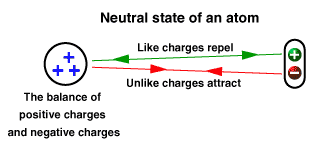
Understanding Electricity Learn About Electricity Current Voltage And Resistance
Energy And Voltage In Circuits The Science Hive


Comments
Post a Comment